

Boots, Beauty & the Digital Right
accidentally launched the first fashion discourse of 2026 + how Vogue rolled over for a racist mob.

Happy New Year, Discoursted gang!!!!
I hope you’re all doing well on this Friday! You know I feel really good about 2026 and where I want to go with this newsletter. Im doing the whole new year new me dog and pony show. I’m going to start doing my podcast on here, along with live videos, because I genuinely feel like this is the platform where I should be investing more time and energy, especially compared to Instagram.
I don’t know if you saw this, but Instagram head Adam Mosseri posted something recently that’s still giving me pause. He announced that the era of the edited feed with polished, professional content is basically dead, thanks to AI being able to replicate it. As platforms evolve to grow with AI and harness its power, he said the focus is shifting to verifying and “fingerprinting” real media. In this new AI-driven creator economy, success will hinge on trust-building and how well you can blend AI with personal authenticity.
AY YI YI.
I’ve been on the internet and social media since I was 12 years old. I’m 35 now. I’ve jumped from coding MySpace layouts, to posting drunk frat party photos on Facebook, to running a fashion blog, to jumping on Instagram, finding early success on Twitter that led to my first fashion jobs, starting a YouTube channel, pivoting to TikTok and Reels, doing general on-camera work as a journalist, and now joining Substack.
When I tell you… I am tired.
I don’t want to compete with people making slop videos of the Stranger Things cast wearing Gucci. I want to make mycontent, reach my followers, and see stuff from my friends. Real stuff. Not them generating themselves into Chanel’s subway collection. Yes……they’re doing that.
So I think this is the year I prioritize Substack.
Anyways, enough of that.
I have good news and bad news. Good news: Zohran Mamdani is Mayor of NYC. Bad news: I think I may have sparked the first “scandal” of his mayorship.
Let me explain.
If you’ve noticed lately, I’ve been on a bit of a political beat here. I’ve also started contributing to Everything Is Political, the platform founded by the brilliant Céline Semaan of the Slow Factory Foundation. Over on Twitter, a fun hobby on hftwt (high fashion Twitter) is ID-ing looks.
So while scrolling through the news, I came across photos from Zohran Mamdani’s midnight swearing-in ceremony in the subway. His wife, Rama, was by his side looking so fucking cool in a naaaastyyyy boot that looked familiar. Naturally, I started searching through boot brands and identified them as Miista’s Shelley boots.
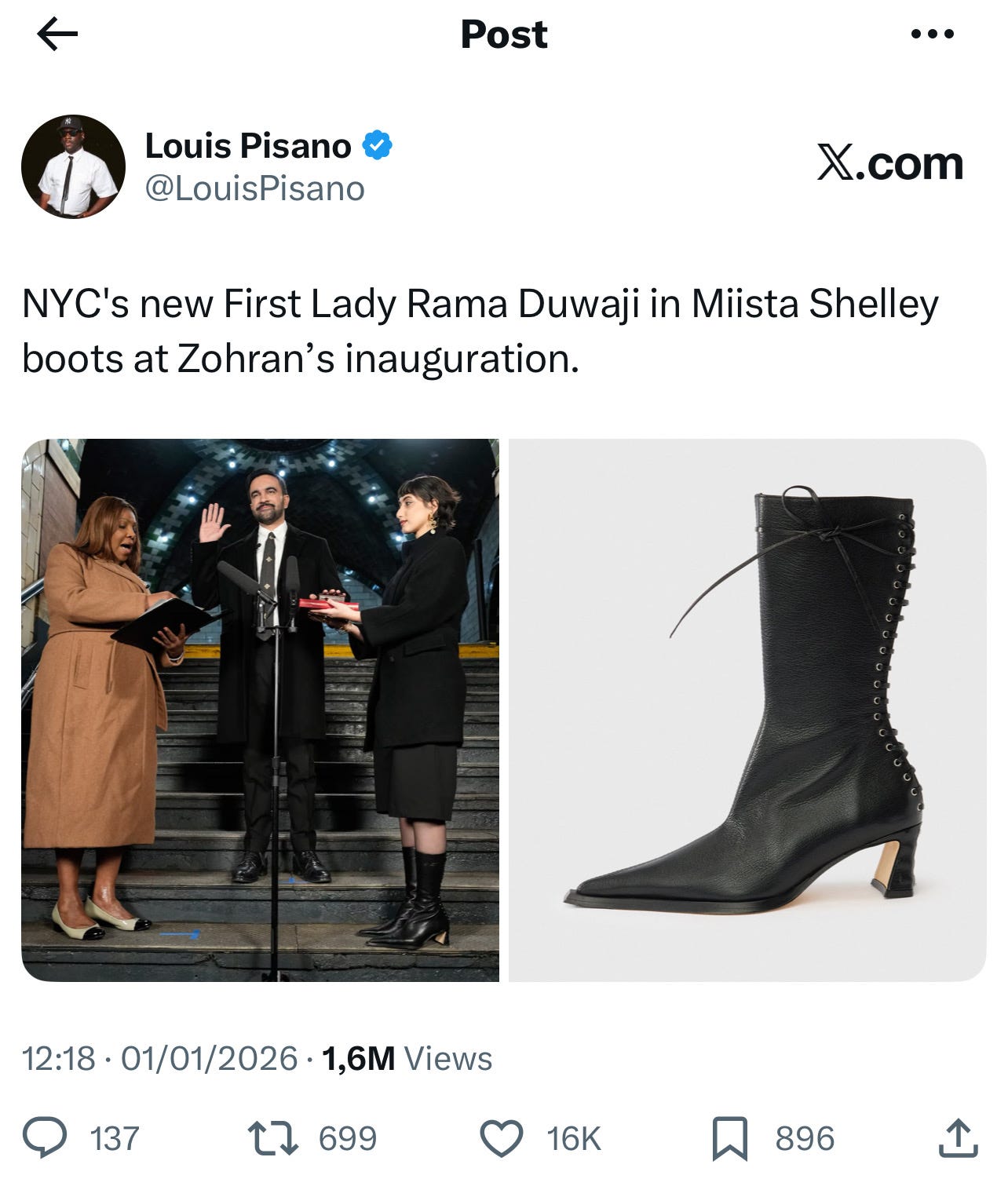
I tweeted that specifically for the hftwt audience because, hello—we have a cool, young Millennial mayor and First Lady who dress like people I know instead of like our parents and grandparents. All was well.
I took a nap.
Let me tell you… I woke up to that tweet sitting at 1 million views. The comment section was flooded with MAGA folks and right-wingers from across the globe, spewing digital bile—calling her a hypocrite because apparently socialists aren’t supposed to wear designer boots, along with a heavy helping of the trademark racism we’ve come to expect from the red hat gang.
The cesspool that is the NY Post wrote a story about the reaction to my tweet. So did the Daily Fail—excuse me, Mail. It’s not lost on me that just hours earlier, that same NY Post praised Melania Trump for wearing a $1,450 dress. Lol.
Forbes contributor Chloe Kennedy made a really interesting point on Twitter when she said:
“Expensive clothing can’t be reduced to anti-socialism when the cheaper alternative (fast fashion) is pro–exploited labor. When the mission of capitalism is to withhold as much profit from the laborer, people of means should buy from brands with transparent supply chains.”
Miista is famously known for products handmade in Spain and Portugal, with a transparent supply chain and ethical sourcing.
But guess what—PLOT TWIST.
The boots were on loan from the brand, styled by… GABRIELLA KAREFA-JOHNSON, who also wrote a fun little piece about the experience of styling NYC’s First Lady.
Go read it here.
The larger point I wanted to make in all of this is: once upon a time, there were communities on Twitter, and each community was like an island. If you wanted to talk about fashion, it was a safe space; if you were into, idk, gaming, you could nerd out in peace, etc., etc., etc. Well, those islands are no more thanks to the hellscape that Elon Musk has turned the app into. You could make the most innocuous post and, like bats out of hell, all the right-wing accounts that Elon prioritizes will find it, amplify it to their troglodyte following, and ignite a shitstorm directed at you. I’ve especially noticed this when it comes to viral fashion and beauty posts lately.
Now, I wrote last week about how the Right hijacked “hot,” their war of aesthetics, and how they attack people who don’t conform to their aesthetic guidelines. Well, we got a glaring example heading into the New Year. Vogue writer Emma Specter wrote a great opinion piece entitled “Mourning Brigitte Bardot Doesn’t Mean Absolving Her.” The article acknowledged Bardot’s beauty, talent, and animal rights activism but argued these should not overshadow her later controversies, specifically, her multiple convictions in France for hate speech (often related to anti-Muslim statements), support for far-right figures like Marine Le Pen, and dismissive comments on #MeToo.
Specter wrote: “It’s our collective responsibility not to let Bardot’s legendary beauty and talent obscure the ugliness of her Islamophobia, sexism, and far-right apologia.” She framed Bardot’s embodiment of “perfect” white womanhood as tied to systemic marginalization and racism persisting in France today.
The piece ignited a firestorm online, particularly on Twitter, where critics slammed it as disrespectful, poorly timed (published mere days after Bardot’s death), and ideologically driven. Many accused Specter of jealousy or hypocrisy, especially given her own advocacy for body positivity and queer issues (she’s the author of a 2024 memoir on binge-eating and fat liberation). The backlash quickly turned personal and vicious, with thousands of posts juxtaposing glamorous photos of Bardot with images of Specter, mocking her weight, looks, and fitness to write for a fashion magazine like Vogue. Viral memes and side-by-side comparisons circulated, with comments calling the critique ironic coming from someone who doesn’t fit traditional beauty standards.
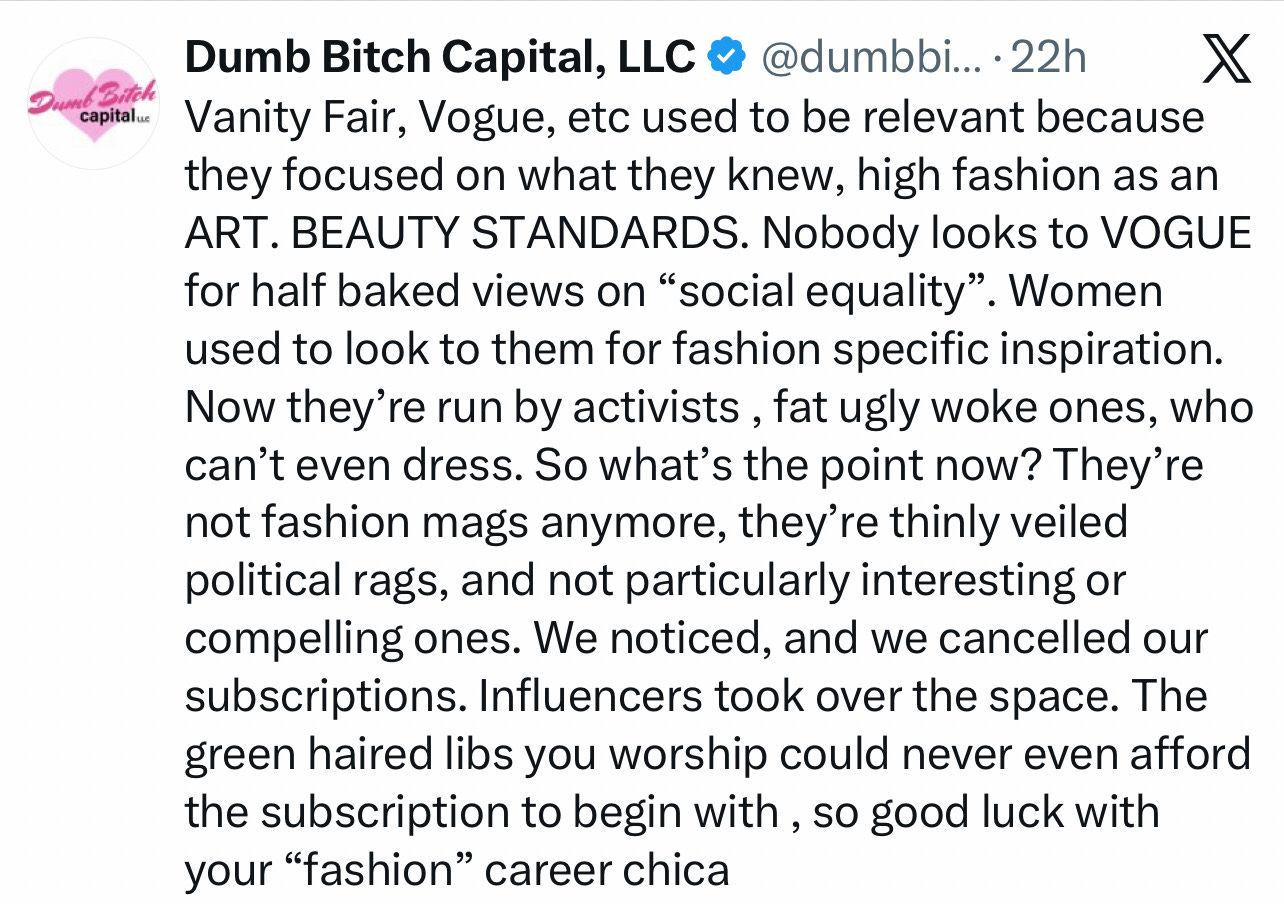
There was also a very disturbing undercurrent of antisemitic insults, with several critics weaponizing Specter’s Jewish identity (which she has openly discussed in her writing on topics like Yom Kippur, Passover, and Jewish cultural experiences) as a means of attack. Posts accused her of jealousy toward “unapologetic white” icons like Bardot specifically because she is Jewish, invoked tropes of “Jewish nepotism” to explain her position at Vogue, or suggested an inherent animosity from Jewish women toward white gentile beauty standards. These comments highlighted how the controversy devolved into overt ethnic and religious bigotry for some participants, framing her criticism as motivated by tribal resentment rather than ideological disagreement.
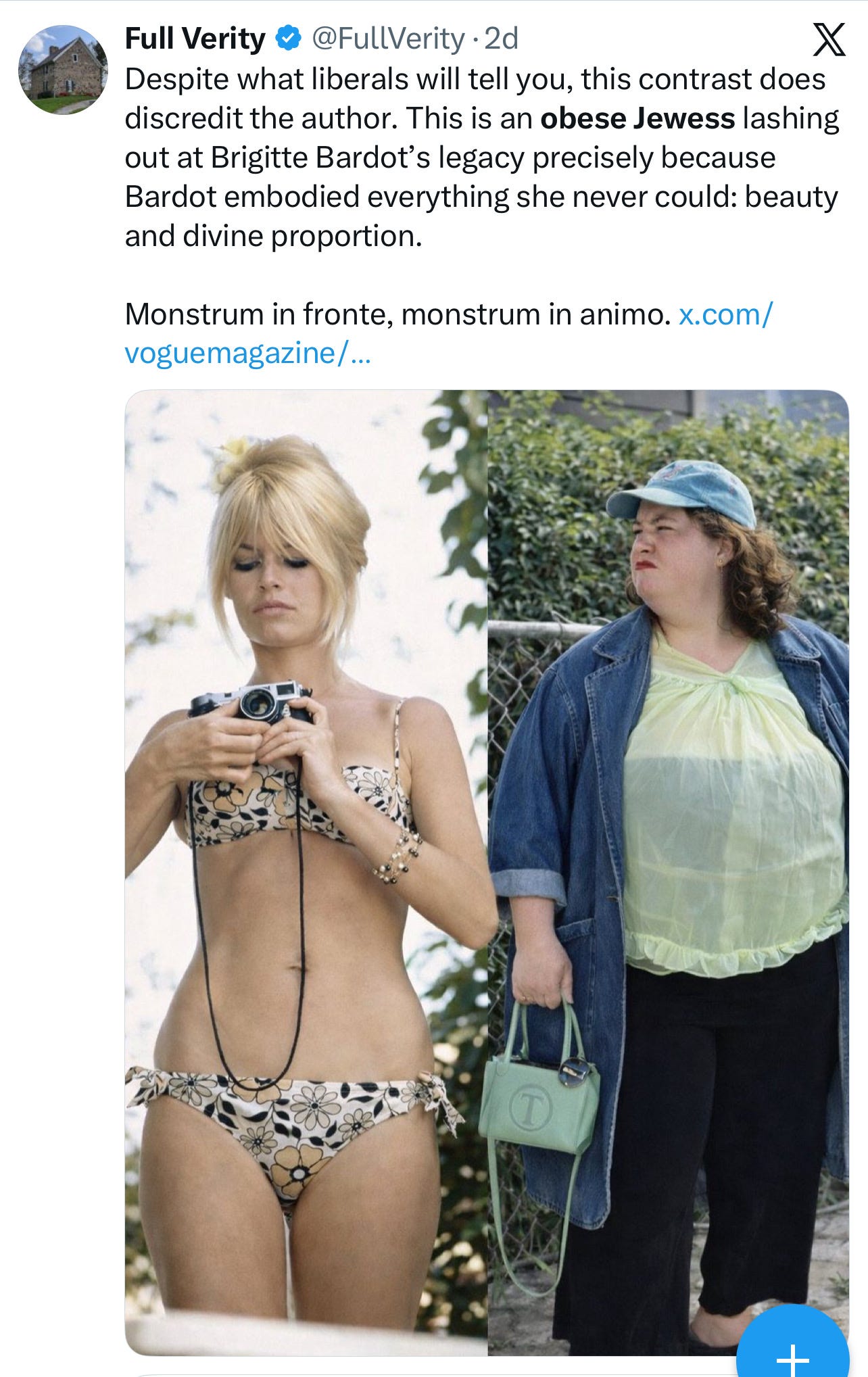
But there was one particular comment that stood out to me and captured how these people’s minds work. Online personality Chloe Happe wrote above a picture of Emma:
“Aesthetic ugliness aside, allowing oneself to reach this level of obesity is indicative of an extreme sickness of the mind. A sickness of the mind rooted so deep inside of oneself that it expands outwards evermore, unable to be contained, polluting the corporeal form. Obese people hate themselves. Internal hatred rooted so deeply should mean your opinion is disregarded by the masses. This extreme sickness of mind is not compatible with journalism, cultural commentary, writing opinion pieces.”
For these people, when you don’t conform to their aesthetic ideology, you are nothing. You are subhuman. You should not exist. You’re a “fat,” a “gay,” a “Black,” a “Jew,” and unfortunately, these people—who once upon a time were a fringe group of lunatics largely shunned by polite society—have been amplified and given an audience. With their newfound power, they now feel like the arbiters of societal guidelines and compelled to speak the way they do because, as I stated earlier, they don’t see their targets as human.
A day later, Vogue deleted the tweet about Emma Specter’s article, in extreme cowardice, in my opinion. Really great start to 2026, huh? When racist right-wing trolls can bully magazines into submission.
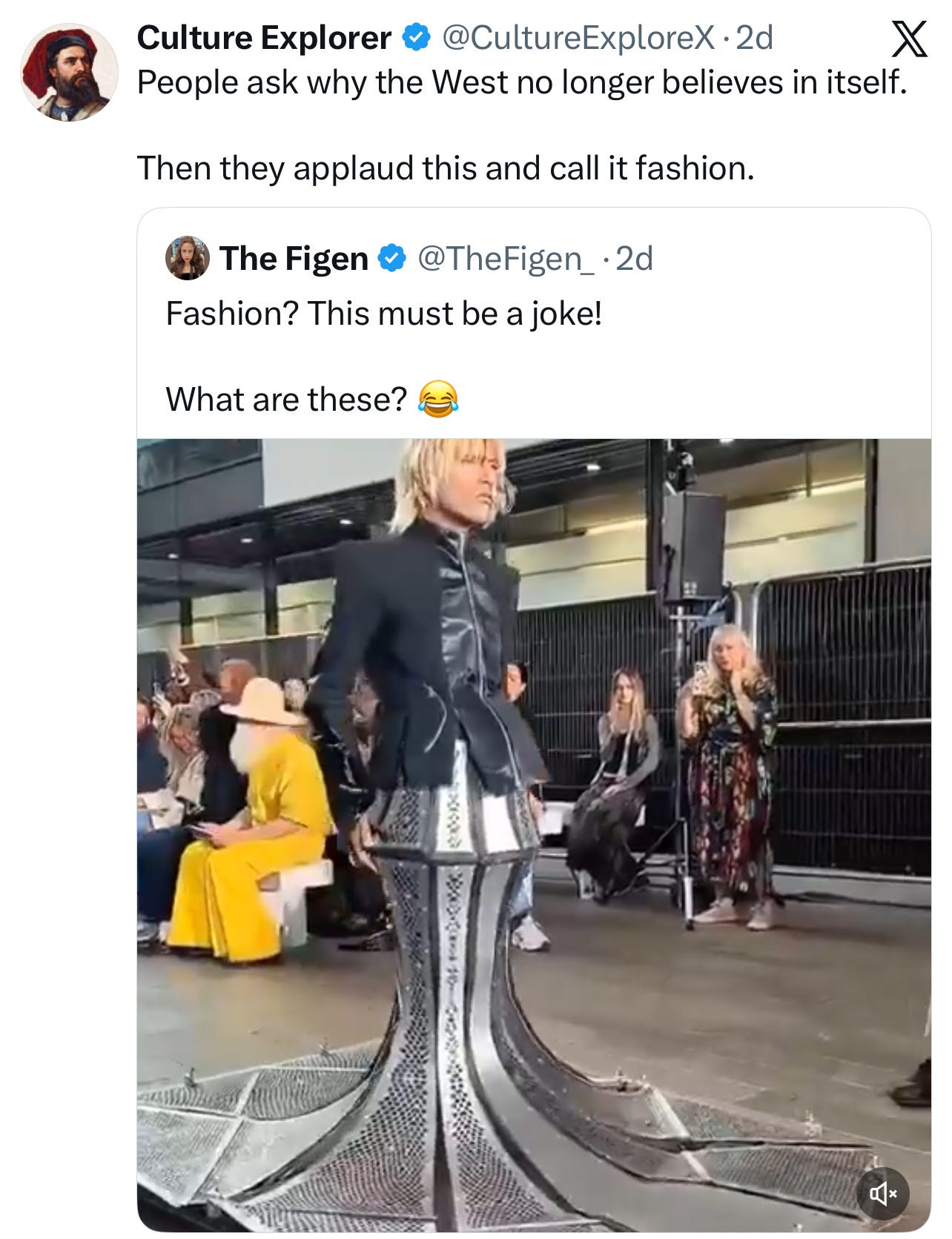
However, this was not the only fashion topic in the Right’s crosshairs. The 2025 Central Saint Martins BA fashion show started going viral, and I always know when I start to see clips from this particular show that the comments are about to be on some bulkshit. The show is below.
Something I’ve noticed in the past few years among right-wing accounts is that they have a personal grievance with modern art and the avant-garde. For them, it represents the degradation of society, and avant-garde fashion is a sign that “the West has fallen” and we need to return to classical ideals—bla bla bla. You know who made this sort of ideology his whole shtick? Adolf Hitler. These were literally his talking points. He was obsessive about aesthetics: he banned modern art, literally labeled it “Degenerate Art,” and promoted idealized classical realism. For Hitler, aesthetic order = moral order = political order.
I know it sounds extreme, but this moment we’re in now is one where the wall between fashion and fascism is so thin. I am terminally online all day: I wake, I check Twitter, I’m very immersed in what’s going on in digital spaces, and there is a pressure bubbling up from prominent voices on the internet and from politicians, where they are putting out aesthetic propaganda nonstop. One day it’s bullying a Jewish Vogue writer and getting the magazine to capitulate to a racist mob; the next, it could be Jeff Bezos buying Vogue and issuing aesthetic guidelines (I know I’m exaggerating). But I do think it’s something to keep an eye on.
CHEERS TO MORE OF YOU, YOUR MIND AND OPINION, HERE ON SUBSTACK ! ONWARDS 🤘🏼
As much as the "right" claims to hate Vogue, it's obvious they just wish they had their own version of it: where style is more than clothing—it’s identity, expression, and voice. The problem with these delusional f--ks is they inspire nothing of value that actually moves. Their fast-moving trends begins and stops at the avatars created online and the grievances posted on their accounts. Of course, these people have resulted to hurling insults. Anything that celebrates creativity without rules: bold looks, personal stories, and culture shaped by real people are met with resistance and hostility.